






2026/04/28 Microsoft Cloud Solutions 423 visit(s) 3 min to read
Ctelecoms
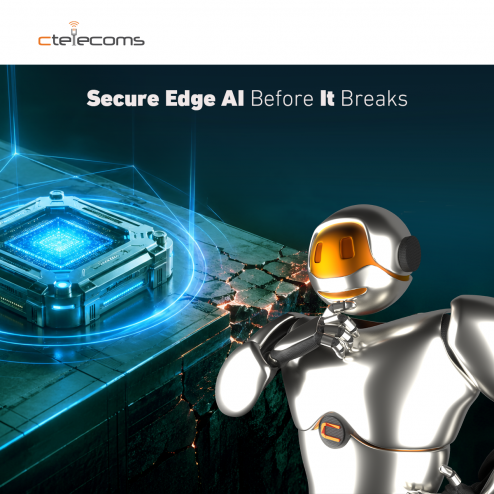
In Saudi Arabia, businesses are now running intelligence closer to the action — inside factories, stores, branches, logistics networks, healthcare sites, and smart infrastructure — to make faster decisions and improve operations.
But there is a catch: the same edge that makes AI more efficient also makes it more vulnerable.
When AI models run outside the central data center, they are exposed to new security risks — from device tampering and unauthorized access to data leakage, model manipulation, and weak governance. In other words, edge AI can deliver speed and intelligence, but without the right protections, it can also become the easiest part of the environment to attack.
For organizations in Saudi Arabia building digital-first operations, the question is no longer whether to deploy edge AI. It is how to secure it before it breaks.
Most organizations focus on what edge AI can do: improve response times, reduce bandwidth usage, and enable real-time intelligence. What often gets overlooked is the operational security gap that appears once AI moves outside the controlled boundaries of core infrastructure.
At the edge, devices are often distributed across many locations, managed by different teams, and connected through diverse networks. That makes consistent enforcement harder. A weak endpoint, an unpatched system, or an over-permissioned user account can create an entry point into the broader AI environment.
The pain point is simple: edge AI increases business agility, but it also expands the attack surface.
For IT teams, this means more than traditional endpoint protection. It requires security measures that are designed specifically for AI workloads, distributed systems, and sensitive data flows.
Edge AI environments are different from centralized systems in a few important ways.
First, data is processed close to the source. That improves performance, but it also means sensitive information may never reach the safer boundaries of a core data center. If a device is compromised, the attacker may gain access to local data before it is encrypted, filtered, or anonymized.
Second, AI models themselves become assets worth protecting. If a model is altered, extracted, or reverse-engineered, the impact goes beyond downtime. It can lead to inaccurate decisions, business disruption, or exposure of proprietary logic.
Third, edge environments are often harder to monitor. Many organizations still lack full visibility into every device, workload, and access path. Without that visibility, it becomes difficult to detect suspicious behavior early.
This is why edge AI security is not just an IT issue. It is a business continuity issue.
A strong edge AI security strategy should protect four layers:
The physical and virtual edge environment should be hardened from the start. That includes secure boot, firmware integrity, patch management, and strong identity controls for every connected asset.
Sensitive data should be encrypted end-to-end, with strict policies controlling what is stored locally, what is transmitted, and who can access it. Data minimization is especially important at the edge.
Models should be signed, verified, and isolated from unauthorized changes. The training and inference pipeline should include access controls, version tracking, and validation to reduce the risk of tampering.
Zero-trust principles should extend to edge AI. That means verifying every user, device, and request, while limiting privileges to the minimum necessary.
For Saudi enterprises, secure edge AI should be designed as part of the architecture, not added after deployment.
A practical approach includes:
The goal is to create an environment where edge AI can operate with speed, but without sacrificing control.
Saudi Arabia is investing heavily in digital transformation, smart cities, industrial automation, and AI-led services. That makes edge AI a strategic enabler for sectors such as telecom, energy, healthcare, retail, logistics, and government services.
But growth without security creates risk.
As organizations expand AI deployments across distributed locations, they need infrastructure partners who understand both performance and protection. Secure edge AI is not about slowing innovation. It is about making innovation sustainable, resilient, and trustworthy.
For businesses in the Kingdom, this is especially important as data governance, operational resilience, and regulatory expectations continue to rise.
At Ctelecoms, we help organizations build the digital foundations needed for secure, scalable, and intelligent operations. That includes infrastructure and services that support modern edge environments, stronger governance, and better visibility across distributed systems.
If your business is deploying AI at the edge, now is the time to ask a critical question: is it built to perform, or is it built to survive?
Because in edge AI, security is not a final step. It is the starting point.

Upgrade your IT to be as agile and efficient ...