






2026/07/26 IT & Cyber-Security Solutions 156 visit(s) 3 min to read
Ctelecoms
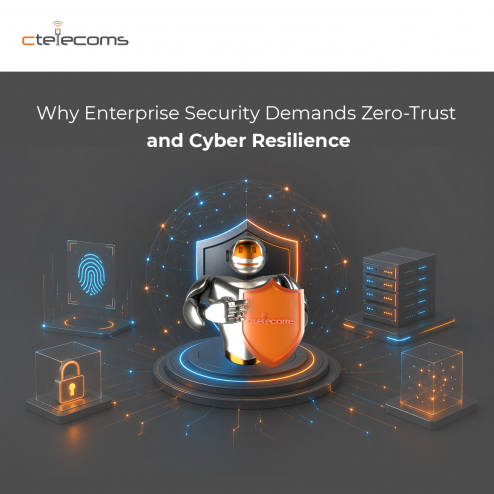
For decades, corporate cybersecurity operated on a simple premise: build a wall around your network, keep the bad actors out, and assume everything inside the perimeter is safe.
But in today’s hyper-connected, cloud-driven corporate world, that perimeter no longer exists.
With data distributed across hybrid clouds, remote workforces, and thousands of interconnected devices, relying solely on preventative defense is a critical vulnerability. As we navigate the complex threat landscape of 2026, leading Saudi enterprises are shifting their strategy from basic cybersecurity to a dual approach: Cyber Resilience paired with a strict Zero-Trust architecture.
Here is why changing your security mindset from “How do we prevent a breach?” to “How do we survive one?” is the ultimate key to business continuity.
Traditional cybersecurity focuses almost entirely on prevention—stopping attacks from penetrating your systems. While prevention remains vital, Cyber Resilience acknowledges a modern reality: no defense is 100% impenetrable.
Cyber resilience is an organization's ability to anticipate, withstand, recover from, and adapt to adverse cyber events. Instead of just measuring how many attacks you blocked, a resilient framework focuses on:
To achieve true cyber resilience, your infrastructure must be governed by a Zero-Trust architecture. This model eliminates the outdated concept of "implicit trust." It treats every user, device, and network request as a potential threat, regardless of whether it originates inside or outside the corporate office.
Under a strict Zero-Trust framework, security is continuously enforced across two critical vectors:
Every access request is continuously authenticated, authorized, and validated before granting minimum required privileges. If a user’s behavior deviates even slightly from their normal pattern, access is dynamically restricted until identity can be completely re-verified.
Today's enterprise perimeter extends to thousands of Endpoints—from corporate smartphones and laptops to point-of-sale (POS) systems and complex logistics hardware.
Zero-Trust requires these devices to be self-managing and self-defending. Modern endpoint solutions autonomously monitor device health, deploy security patches over-the-air (OTA), and isolate compromised equipment from the main corporate network instantly—without waiting for human IT intervention.
For enterprises operating within the Kingdom, implementing these advanced frameworks is not just a strategic choice; it is highly aligned with national priorities. As organizations expand digital operations to match Saudi Vision 2030 mandates, maintaining compliance with the National Cybersecurity Authority (NCA) guidelines requires robust, verifiable access controls and clear business continuity protocols.
Adopting Zero-Trust and Cyber Resilience ensures your company protects its market reputation, avoids crippling regulatory fines, and secures its financial assets against sophisticated global threats.
Transitioning your enterprise infrastructure to a unified Zero-Trust and cyber-resilient model requires a highly coordinated approach across networks, cloud systems, and identity frameworks.
As a premier cybersecurity and IT services provider in Saudi Arabia, Ctelecoms partners with organizations to audit, design, and implement comprehensive security architectures. We specialize in deploying automated endpoint security, Zero-Trust identity verification systems, and highly resilient backup and disaster recovery solutions tailored to keep your business running smoothly, no matter what.
Is your enterprise built to withstand the next generation of cyber threats? Contact Ctelecoms today to evaluate your security posture and build a resilient framework for your business.

Upgrade your IT to be as agile and efficient ...